
Investing in commercial property can work well if the numbers stack up and you are prepared to hold for the long term. The core principles are similar to residential property, but the risks, deposit requirements and lease dynamics are different enough that they deserve a closer look before you commit.
You do not need to run a business yourself to invest in commercial property. What matters more is understanding your likely tenants, the quality of the lease, and how easily the property could suit a different tenant if your current one ever moves on.
What to think about before you buy a commercial property
Before you buy, spend real time understanding the tenant market for that property type and location. Look at local infrastructure, transport links and nearby amenities, since these all affect how easy the property will be to lease, now and in the future.
It is also worth thinking about flexibility. A property that could suit more than one type of business is generally a safer bet than one built around a single, specific use.
One thing that catches new commercial investors off guard is timing. Tenant turnover and property sales both tend to move more slowly in commercial property than in residential, so patience matters more here.
The advantages of investing in commercial property
- Higher income potential. Commercial property typically yields somewhere in the order of 5 to 12 percent, compared with roughly 3 to 4 percent for residential property, which can support stronger cash flow depending on how the purchase is financed.
- Built in rent increases. Commercial leases commonly include fixed annual rent increases as a standard lease term, giving you more predictable income growth than many residential tenancies.
- Longer lease terms. Commercial tenants often sign longer leases than residential tenants, which can mean more stable, less frequent turnover.
- Tenants usually cover outgoings. Council rates, land tax, insurance and day to day maintenance are commonly paid by the tenant under a commercial lease, rather than the owner.
- Potential tax efficiency. Depending on the entity you buy through, a company, trust, self managed super fund, or partnership, and the depreciation available, commercial property can be a tax effective way to invest. Speak with your accountant about what applies to your situation.
The disadvantages of investing in commercial property
- Greater sensitivity to the economy. Commercial property demand is closely tied to business conditions, so a downturn in a particular industry or the broader economy can affect your tenant and your income.
- Longer vacancy periods. When a commercial tenant leaves, it typically takes longer to find a replacement than it would for a residential property. You need to be able to service the loan and cover holding costs during that time.
- More expensive to repair and renovate. An untenanted commercial property can be costly to prepare for a new tenant, particularly if the previous occupant’s fit out needs to be removed.
- More complex leases. Commercial leases involve more negotiation and variation than a standard residential tenancy agreement, and you will often need an accountant or lawyer involved.
What can you use as security for a commercial property loan
You can generally secure a commercial property loan against your own home, another residential property you own, or the commercial property itself.
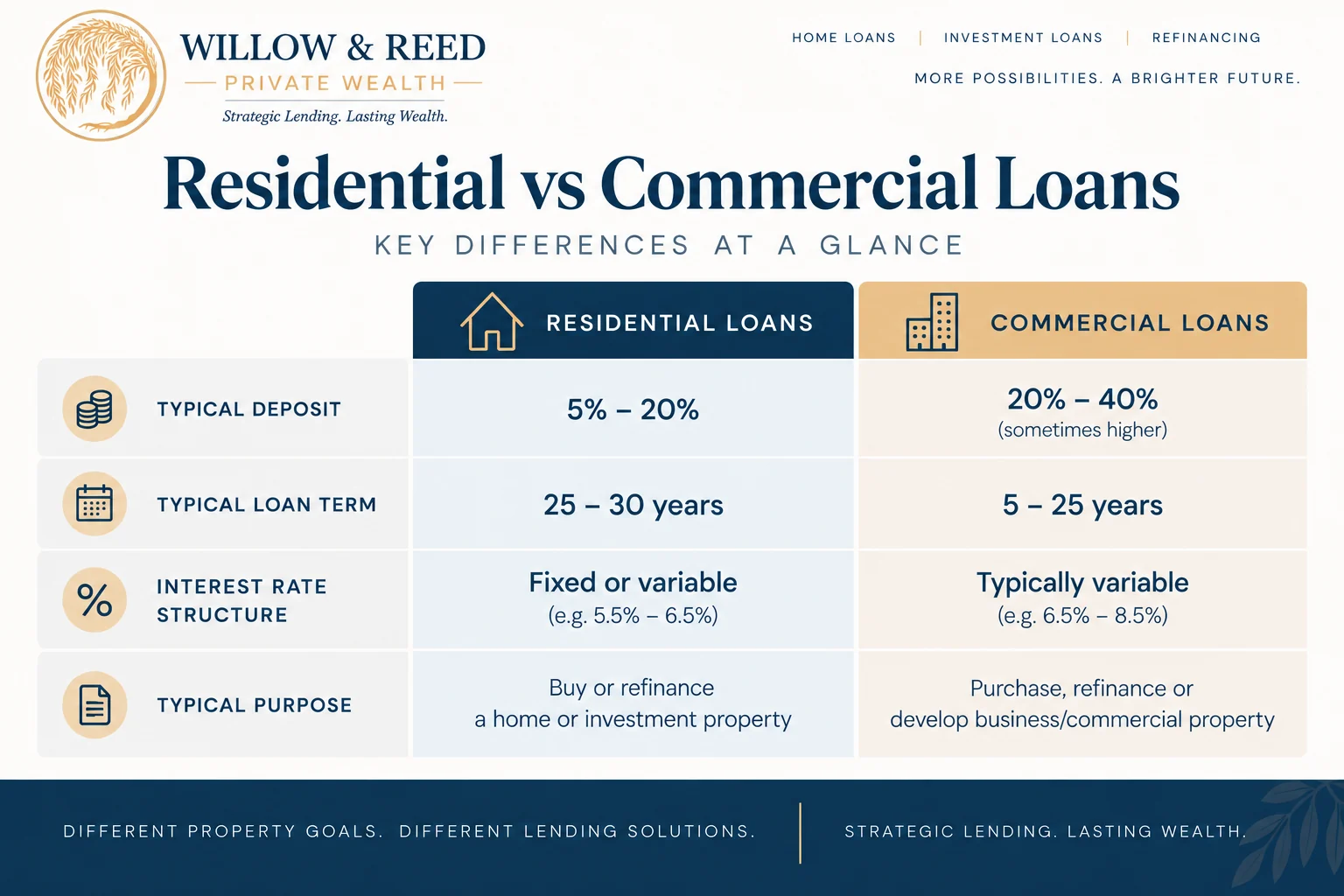
Lenders typically see commercial property as a higher risk investment than residential property, so they usually ask for a larger deposit, sometimes as much as 30 to 40 percent, along with a somewhat higher interest rate and higher fees.
If you use residential property as security instead, you can often access a lower interest rate, fewer fees, and potentially borrow up to the full value of the commercial property, using your available home equity to fund the deposit.
Commercial lending has also become more accessible over time. Some lenders now offer loan to value ratios up to around 80 percent and terms stretching to 15, 20 or even 25 years, although your interest rate will still be adjusted for the perceived risk of your specific loan and LVR.
How to approach your first commercial property purchase
Here is how I would summarise the key things to keep in mind.
- Do your research properly before you commit to a property or a suburb.
- Use the professionals around you, your accountant, lawyer, financial adviser and mortgage broker, rather than going it alone.
- Plan for the worst case, including an extended vacancy, so you know you can service the loan regardless.
- Avoid an untenanted property for your first purchase. A property with an existing tenant on a long or recently renewed lease reduces your early risk.
- Do not be swept up by advertising. Crunch your own numbers and compare similar properties in the area rather than relying on a headline yield.
- Do not rush. Commercial property deals move more slowly than residential ones, and there is rarely a good reason to skip your due diligence.
- Keep an open mind on location and property type. The right opportunity is not always the first or most obvious one you look at.
Buying commercial property through your SMSF
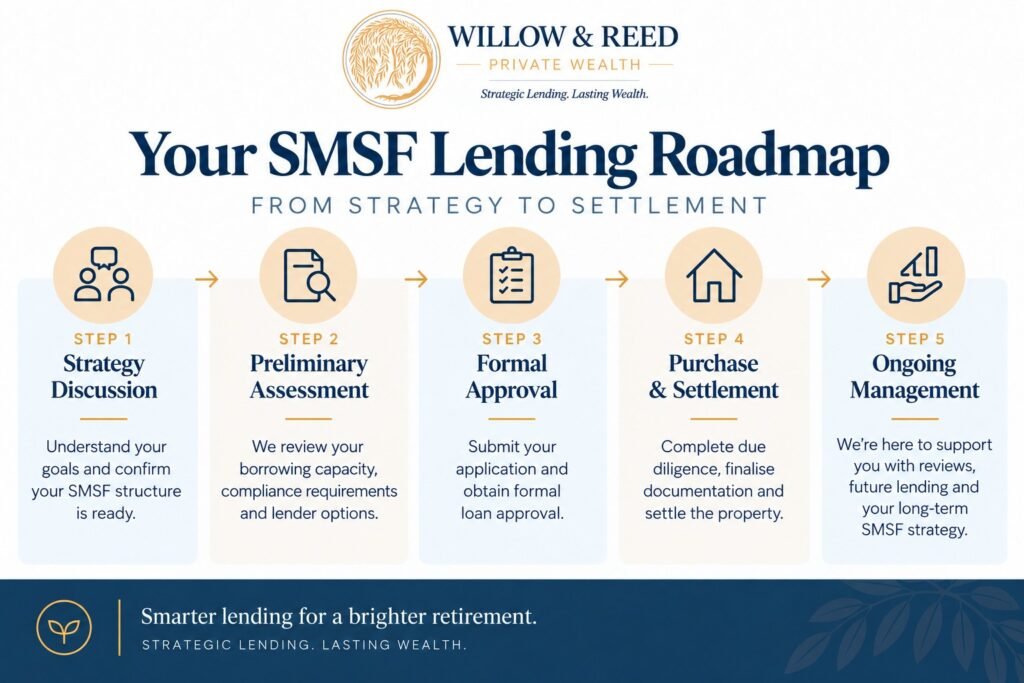
Commercial property is also a common asset inside a self managed super fund, particularly for business owners who want their fund to own the premises their own business operates from. If this is something you are considering, I have set out the key things to check in 7 key considerations when buying commercial property through an SMSF and in your SMSF lending roadmap.
Frequently asked questions
Is commercial property riskier than residential property?
It carries different risks rather than simply more risk. Commercial property is more sensitive to economic and industry conditions, and vacancies tend to last longer, but it can also offer higher rental yields and longer lease terms than residential property.
How much deposit do I need for a commercial property?
Lenders typically ask for a larger deposit than they would for residential property, often in the order of 30 to 40 percent, because commercial loans are viewed as higher risk. Using residential property as security can sometimes reduce this requirement.
What kind of rental yield can I expect from commercial property?
Commercial property yields are typically higher than residential, often somewhere between 5 and 12 percent, compared with roughly 3 to 4 percent for residential property. Your actual yield will depend on the property, location and lease terms.
Who pays the outgoings on a commercial property, the owner or the tenant?
Under most commercial leases, the tenant covers outgoings such as council rates, land tax, insurance and day to day maintenance, which is different from most residential tenancies.
Can I buy a commercial property through my SMSF?
Yes, this is a common structure, particularly for business owners buying the premises their business operates from. There are specific rules and lending conditions to work through, which I cover in more detail in my SMSF lending articles.