

The CGT reform coming into effect on 1 July 2027 isn’t just a compliance change to absorb, for a high-income professional already sitting in the top marginal bracket, it genuinely changes how a portfolio should be built, timed and structured from here. The 30% minimum rate barely moves the needle for someone already paying more than that, but the indexation mechanic and the transitional valuation window create real, usable planning opportunities in the next eighteen months.
This isn’t a client case study, it’s the strategic conversation I’ve been having with clients since the reform received Royal Assent, because the professionals who plan around the transition properly will keep more of what they’ve built than those who let 1 July 2027 arrive without a plan.
Why the 30% floor barely affects you, but indexation genuinely does
If your marginal tax rate already sits above 30%, the minimum rate itself isn’t the part of this reform that changes your outcome, you were always going to pay more than 30% on a capital gain. What actually shifts is the move from a flat 50% discount to cost base indexation, since you’re now taxed on the real, inflation-adjusted gain rather than the full nominal gain. For an asset held over a long period through a high-inflation stretch, that can meaningfully reduce the taxable gain compared to how it would have been assessed before, particularly for assets bought many years ago at a much lower nominal cost base.
The strategic point is simple, don’t assume this reform is a straightforward loss because the discount is gone, work out what indexation actually does to your specific assets before drawing that conclusion.
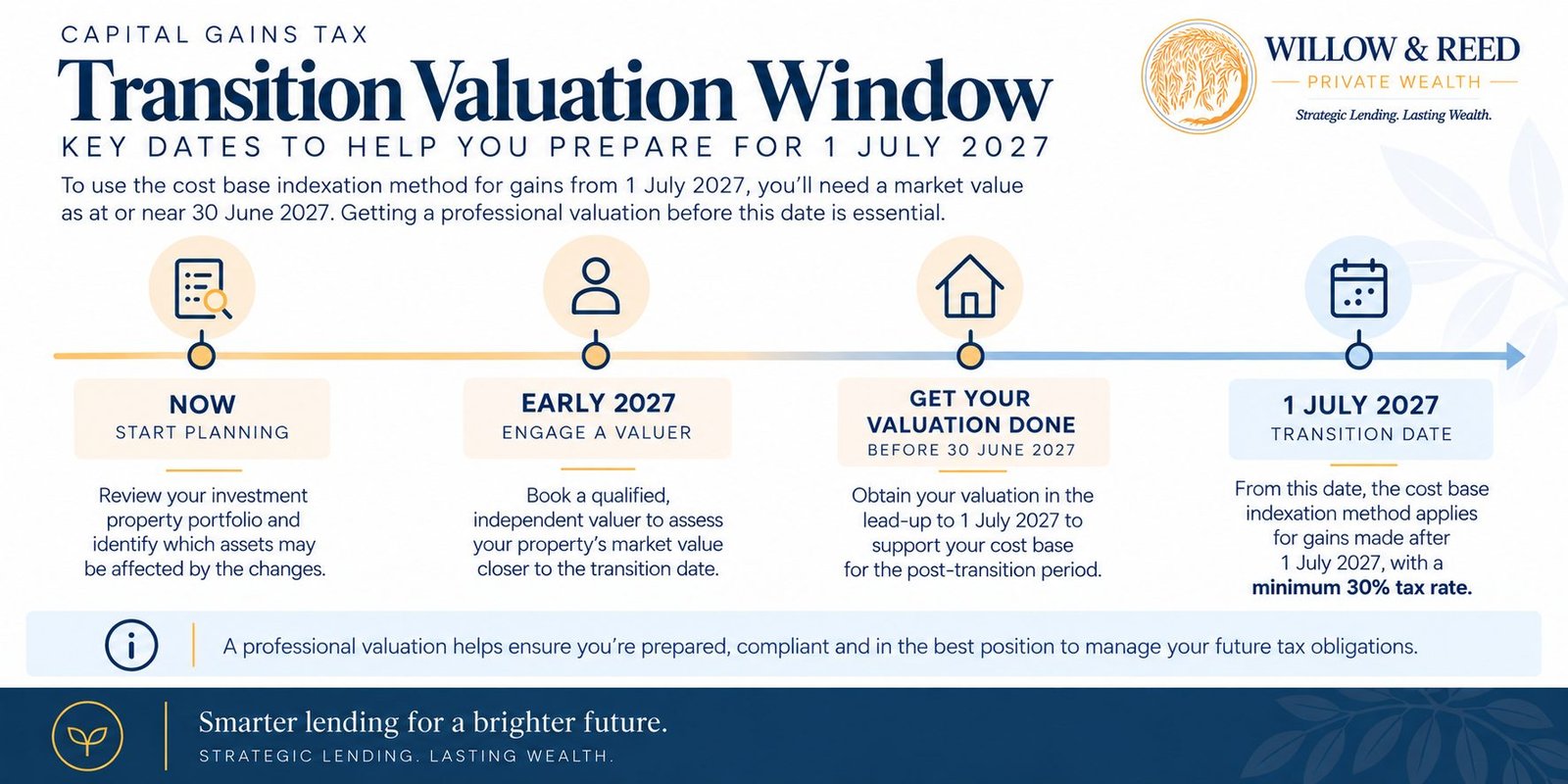
The transitional valuation window is the single biggest planning opportunity
Every asset you hold across 1 July 2027 has its gain split, the portion accrued before that date keeps the 50% discount, the portion after is taxed under indexation and the 30% floor. That split is determined by a formal market valuation or an ATO apportionment formula as at the transition date.
- A formal, defensible valuation at or near 1 July 2027, for property, a private business interest, or any asset without a clear daily market price, locks in the maximum possible gain sitting under the old, more favourable discount treatment.
- For listed shares and ETFs, the market price effectively does this for you, but it’s still worth confirming your broker or platform is capturing the transition-date value cleanly for your records.
- Getting this wrong or leaving it too late risks defaulting to a less favourable ATO apportionment formula rather than your asset’s actual value at the transition date, which can mean more of the gain lands in the new regime than it needed to.
This is a genuine, time-limited planning action, not something to leave until you’re preparing a tax return years from now.
Timing a sale around the transition date
If you’re already considering selling an asset in the next year or two, the calendar now matters in a way it didn’t before.
- A sale completed before 1 July 2027 is entirely unaffected, the full 50% discount applies under the current rules regardless of your income that year.
- A sale after 1 July 2027 splits the gain at the transition date, so a documented valuation beforehand protects the pre-reform portion of your gain.
- The old strategy of deferring a sale into a lower-income year no longer reduces the effective rate below 30% the way it once could, so that particular lever largely disappears from the planning conversation from 1 July 2027 onward.
None of this means rushing a sale purely to beat a deadline, but it does mean the deadline is now a real input into when you’d choose to sell, alongside the usual considerations of market conditions and your own goals.
What this means for restructuring conversations already underway
If you’re also weighing up trust or company structures for property or investment holdings, the CGT reform adds another layer worth factoring in alongside the borrowing and lending considerations. Discretionary trusts face a separate 30% minimum tax on their taxable income from 1 July 2028, with a three year rollover relief window opening 1 July 2027 for restructuring, so a structuring conversation already on your radar is worth having sooner rather than later, with your accountant leading the tax analysis and me looking at how any restructure affects your lending position.
This is genuinely a case where the tax, structuring and lending conversations need to happen together, not sequentially.
Is this right for you?
If you’re a high-income professional holding shares, property or a business interest you plan to keep for years yet, the immediate action isn’t selling anything, it’s getting a proper valuation position established for the 1 July 2027 transition.
If you’re already weighing a sale or a restructure in the next one to two years, the transition date is now a genuine factor in your timing, and it’s worth bringing into the conversation with your accountant now rather than closer to the date.
If you haven’t yet read the full detail on what’s changing, new CGT changes explained covers the mechanics of indexation, the 30% floor and the transitional split in plain terms.
Frequently asked questions
If my marginal tax rate is already above 30%, does this reform even affect me?
Yes, but differently than you might expect. The 30% minimum rate itself changes little if your marginal rate is already higher. The part that matters for you is cost base indexation, which reduces your taxable gain to the real, inflation-adjusted amount rather than the full nominal gain, and the transitional valuation opportunity around 1 July 2027.
Should I get a valuation done now, before 1 July 2027?
For assets without a clear daily market price, property or a private business interest in particular, yes, it’s worth discussing with your accountant. A formal, defensible valuation at or near the transition date protects the portion of your gain that accrued under the old, more favourable discount treatment.
Does deferring a sale into a lower-income year still reduce my tax on a capital gain?
Less than it used to, from 1 July 2027 onward. The 30% minimum rate applies to the indexed gain regardless of your income for that year, so timing a sale purely to land in a lower tax bracket no longer has the same effect it once did on a gain taxed under the new regime.
Should I restructure my trust before the 2028 changes take effect?
That’s a genuine conversation to have with your accountant given the three year rollover relief window opening 1 July 2027. It’s not something to decide from a blog post, but it is worth raising now rather than waiting, since the relief window has a defined start and the right approach depends entirely on your specific structure and goals.