

From 1 July 2027, the 50% capital gains tax discount is being replaced with cost base indexation and a 30% minimum tax rate on capital gains, for individuals, trusts and partnerships. If you already hold an asset before that date, the change won’t wipe out your existing discount, but it will change how any gain from here forward is taxed. This is now law, having received Royal Assent on 26 June 2026, so it’s worth understanding properly rather than waiting until it affects a sale you’re planning.
This isn’t a client case study, it’s the plain-English explainer I’ve been giving clients since the reform passed, because the mechanics are genuinely different from anything the CGT system has done since the mid 1980s.
What’s actually changing, in plain terms
Under the current rules, an individual, trust or partnership holding an asset for more than 12 months gets a flat 50% discount on the capital gain, regardless of how much the asset actually grew in real terms. From 1 July 2027, that discount is replaced with two mechanisms working together. Cost base indexation adjusts your purchase price for inflation, so you’re only taxed on the real gain above inflation, not the full nominal gain. On top of that, a 30% minimum tax rate applies to that indexed gain, regardless of your marginal tax rate, unless your marginal rate is already higher, in which case you pay that instead.
Companies aren’t eligible for the indexation benefit under the reform, and income support recipients, including Age Pension recipients, are exempt from the 30% minimum tax floor.
How the transition actually works if you already own the asset
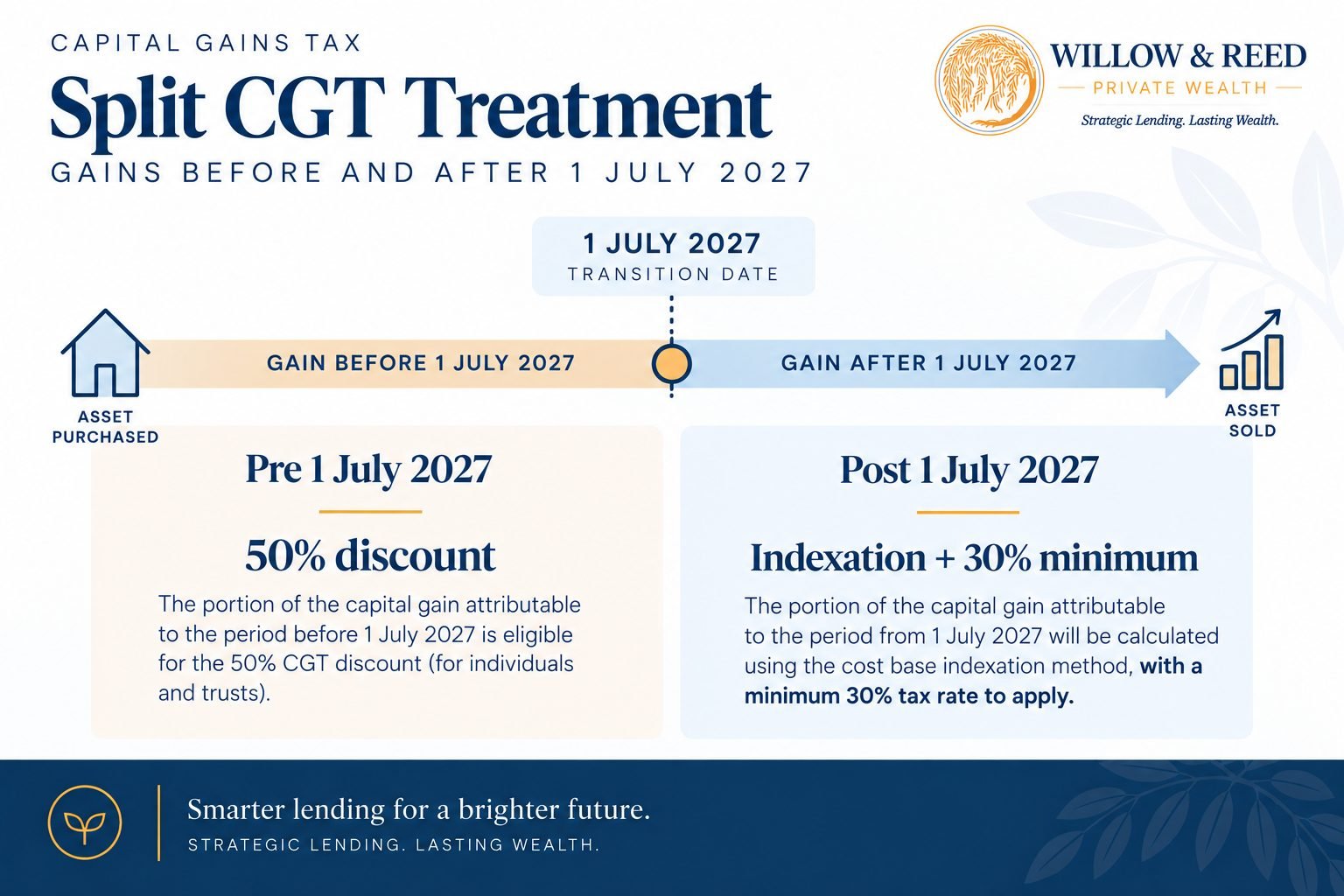
The reform doesn’t simply switch on for every asset on 1 July 2027, it splits the gain.
- The portion of the gain that accrued before 1 July 2027 keeps the existing 50% discount treatment, worked out using a formal market valuation or an ATO-provided apportionment formula as at that date.
- The portion that accrues from 1 July 2027 onward is taxed under the new regime, cost base indexation plus the 30% minimum rate.
- An asset sold before 1 July 2027 is unaffected entirely, the full 50% discount still applies under current rules.
This applies across shares, ETFs, investment property and other CGT assets, so the mechanics are the same whatever you’re holding, only the valuation exercise at the transition date differs by asset type.
The new build election, and what it means alongside negative gearing
For a new build residential property acquired after 1 July 2027, you’ll have a genuine choice, elect the traditional 50% discount, or elect the new indexation approach on the full gain. That choice sits alongside the negative gearing reform, which already limits full negative gearing against your other income to new builds specifically, so a new build purchased after the transition carries two separate elections worth understanding together rather than in isolation.
What this means if you’re holding for the long term
For a long-held asset with strong nominal growth, indexation genuinely helps, you’re not paying tax on the inflation component of a gain you built up over ten or twenty years. But the 30% floor means the old strategy of timing a sale into a lower-income year to reduce the effective rate on a gain no longer works the way it used to, since 30% now applies as a minimum regardless of your income for that year.
For anyone already in the top marginal bracket, the minimum rate itself doesn’t change much, since your marginal rate was already above 30%. The real shift for a high-income professional is the indexation mechanic, and getting the transitional valuation right on assets you already hold.
Is this right for you?
If you’re not planning to sell anything before 1 July 2027, there’s no immediate action required, but it’s worth getting a market valuation done around the transition date so the split calculation is accurate when you eventually do sell.
If you’re weighing a sale that could go either side of 1 July 2027, the timing is now genuinely worth planning around with your accountant, since which side of the line a gain falls on determines which set of rules applies to it.
If you’re also working through how the negative gearing changes affect your next property purchase, it’s worth reading new negative gearing rules explained alongside this one, the two reforms were introduced together and interact directly for new build property.
Frequently asked questions
Do I lose my existing 50% discount on assets I already own?
No. The gain that accrued before 1 July 2027 keeps the existing 50% discount treatment. Only the portion of the gain that accrues from 1 July 2027 onward is taxed under the new indexation and 30% minimum rate regime, based on a valuation or apportionment at the transition date.
What does the 30% minimum tax rate actually mean for me?
It means the indexed capital gain is taxed at a minimum of 30%, even if your marginal tax rate for that year would otherwise be lower. If your marginal rate is already above 30%, you continue paying that higher rate, so the floor mainly changes the outcome for people who would previously have timed a sale into a lower-income year.
Does this affect shares and other investments, or just property?
It applies across shares, ETFs, investment property and other CGT assets held by individuals, trusts and partnerships. Companies aren’t eligible for the indexation benefit. The transitional split treatment applies the same way regardless of asset type.
Should I talk to my accountant before selling anything?
Yes, definitely. This is general information about how the reform works, not personal tax advice, and getting the transitional valuation and timing right depends on your specific assets and goals. I’d always recommend confirming the detail with your accountant, and I’m glad to work alongside them on the lending and structuring side.