

Debt recycling is a strategy that turns non-deductible home loan debt into tax-deductible investment debt, so your mortgage shrinks while you build an investment portfolio at the same time. Here is exactly how it worked for two of my Melbourne clients, Mark and Lisa (names changed for privacy), who reduced their mortgage by $75,000 and grew a $210,000 investment portfolio in eighteen months.
This is a real client result, not a projection. I’m sharing the exact structure we used and the numbers involved, so you can judge honestly whether a similar approach could work for you.
The situation: a mortgage with room to work harder
Mark, 44, is a senior IT consultant. Lisa, 42, works as a marketing director. Together their household income is $420,000, and they’re based in Melbourne.
They bought their family home in 2019 for $1.6 million. By the time they came to see me, their mortgage balance had already come down to $980,000 through solid repayments. On paper that looked like good progress, but Mark and Lisa wanted more than a shrinking mortgage. They wanted their money working on two fronts at once, reducing debt and building wealth for an earlier retirement.
Their concern was timing. Most people wait until the mortgage is fully paid off before they start investing seriously. Mark and Lisa didn’t want to wait that long, but they also didn’t want to put their family home at risk to get there. The brief was clear: find a way to reduce non-deductible debt while building long-term wealth, without changing their day-to-day lifestyle.
Our solution: a debt recycling structure built around their numbers
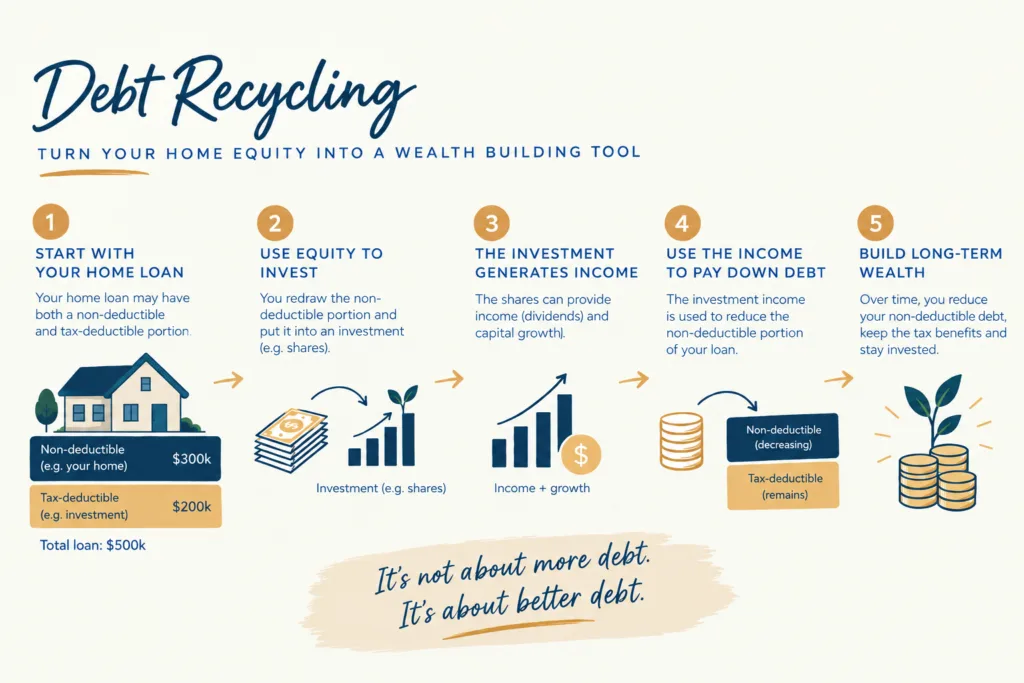
Debt recycling isn’t a single product, it’s a structure. We used the equity in their home to split the loan and put both halves to work toward the same goal.
- Loan split and restructure. We kept $800,000 as their owner-occupied, non-deductible mortgage, and restructured $180,000 into a separate investment loan (deductible).
- Strategic investment. The $180,000 investment loan was drawn down to build a diversified investment portfolio focused on long-term growth.
- Smart cash flow. Their salaries were directed into an offset account linked to the non-deductible loan. Investment income and tax refunds were then redirected back into that offset, accelerating the reduction of the home loan.
- Recycling in action. As the owner-occupied loan balance came down, they reborrowed the same amount under the investment facility and used it to add to their portfolio, repeating the cycle.
Each part of this structure has to work together. Get the loan splits wrong, or mismanage the cash flow, and the tax and wealth benefits disappear quickly. This is why a debt recycling strategy needs proper structuring from the outset, alongside a financial adviser and accountant who understand the tax implications for your situation.
The results after eighteen months
Eighteen months into the strategy, here is where Mark and Lisa landed:
- Non-deductible mortgage reduced by $75,000
- Investment portfolio value grew to approximately $210,000
- Tax-deductible interest increased as the investment loan portion grew
- On track to pay off their home loan eight to ten years sooner than their original loan term
- A growing passive income stream building toward their early retirement goal
None of this happened by accident. It came from a structure that matched their income, their appetite for risk and their long-term time frame.
Why this strategy worked for Mark and Lisa
Debt recycling amplifies whatever financial habits you already have, good or bad. In Mark and Lisa’s case, four things made the difference:
- A strong, consistent household income of $420,000
- Discipline with budgeting and mortgage repayments before we even started
- A genuine long-term investment mindset, not a get-rich-quick expectation
- Coordinated financial, mortgage and tax advice, rather than acting on one piece of the puzzle alone
Take any one of those away and the strategy becomes considerably riskier. Debt recycling increases your investment exposure and your overall borrowing, so it magnifies both gains and losses.
Is debt recycling right for you?
Debt recycling isn’t for everyone, and I say that to every client who raises it, not just in this article. It tends to suit high-income professionals with stable cash flow, an existing comfort with growth investments, and enough of a buffer to ride out a market downturn without panic-selling.
It’s less suitable if your income is variable, if you don’t yet have an emergency buffer, or if the thought of your investment portfolio dropping in value would keep you up at night. The debt doesn’t disappear in a downturn, only the asset value does.
If you’re weighing up debt recycling against other ways to structure your home loan, it’s worth reading about offset accounts versus redraw facilities first, since the offset structure is a core part of how this strategy works. If a faster mortgage payoff on its own is more your focus right now, my article on 11 strategies to help pay off your mortgage sooner covers approaches that don’t involve taking on investment debt at all.
Frequently asked questions
What is debt recycling?
Debt recycling is a strategy that converts non-deductible home loan debt into tax-deductible investment debt. As you pay down your mortgage, you reborrow the same amount to invest, so your money works on reducing debt and building an investment portfolio at the same time.
How much did Mark and Lisa reduce their mortgage by?
In eighteen months, Mark and Lisa reduced their non-deductible mortgage by $75,000 while building an investment portfolio worth approximately $210,000, using a structure built around an $800,000 owner-occupied loan and a $180,000 investment loan.
Is debt recycling risky?
Yes, it increases your overall borrowing and your exposure to investment markets, so it carries more risk than simply paying down your mortgage. It suits people with stable income, disciplined cash flow and a genuine long-term investment mindset, which is why we assess suitability carefully before recommending it.
Who is debt recycling suited to?
It tends to suit high-income professionals and families with consistent cash flow, existing comfort with growth investments and a long time horizon, generally people who are already disciplined with their budgeting and repayments before the strategy begins.
How is debt recycling different from a normal investment loan?
A normal investment loan is simply borrowing to invest. Debt recycling specifically uses the equity being freed up as you pay down your home loan, reborrowing that same amount for investment purposes, so the non-deductible debt and the deductible debt move in opposite directions at the same time.