
Splitting your home loan between fixed and variable portions lets you lock in rate certainty on part of your debt while keeping the flexibility of an offset account on the rest, rather than being forced to choose one or the other for the whole loan. For professionals with a large mortgage and genuine uncertainty about where rates are headed, it’s one of the simplest structural changes that actually reduces risk.
This isn’t a client case study, it’s the structuring conversation I have with almost every client refinancing a loan over $750,000, because “fixed or variable” is usually the wrong question.
Why “fixed or variable” is the wrong question
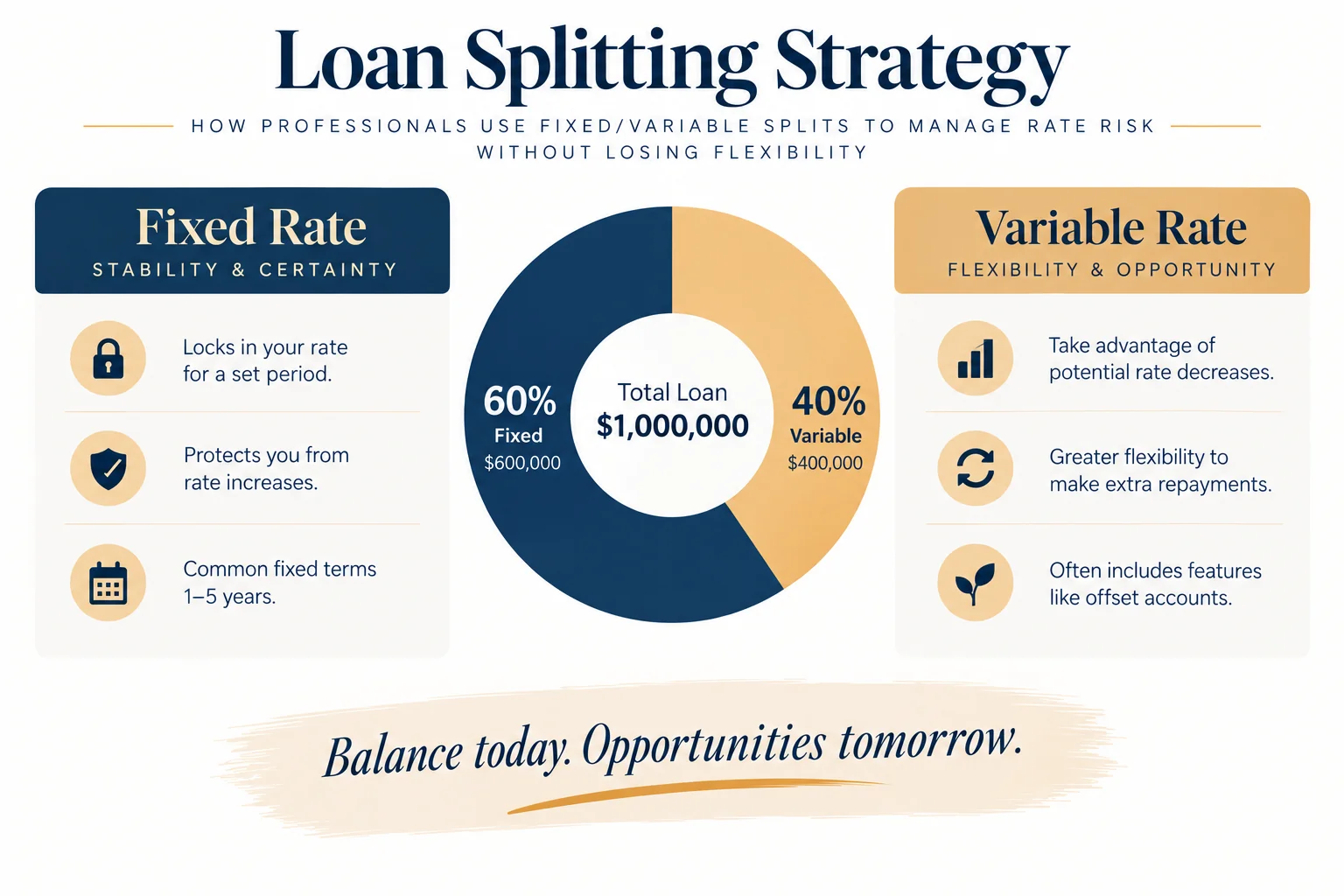
Most borrowers treat this as a binary choice, pick one, live with it. But a loan split simply means dividing your total borrowing into two or more portions, say 60% variable and 40% fixed, each with its own rate and its own rules. You’re not choosing between certainty and flexibility, you’re deciding how much of each you want.
The right split depends on your appetite for rate movement, how much spare cash flow you expect to have for extra repayments, and how close you are to needing full flexibility, for example if you’re planning to sell or refinance again within the fixed term.
How the split actually works in practice
Setting up a split loan is straightforward on the lending side, the complexity is in getting the proportions and terms right for your situation.
- The variable portion carries the offset. Fixed portions generally can’t have a full offset account attached, so keeping enough of your loan variable means your savings still reduce the interest you pay.
- The fixed portion caps your risk. If rates rise, only the variable portion is exposed, and you know exactly what the fixed portion will cost for the term you’ve locked in.
- Terms don’t have to match. You can fix one portion for two years and leave the rest variable indefinitely, or split across three or four portions with different terms if your bank allows it.
Get this wrong, for instance fixing too much and leaving too little offset capacity, and you can end up paying more interest overall despite having “locked in certainty.”
The results a well-structured split delivers
Done properly, a split structure typically achieves a few things at once.
- Predictable minimum repayments on the fixed portion, useful for household budgeting or serviceability on a second loan.
- Continued offset benefit on the variable portion, so genuine savings keep reducing real interest paid.
- Reduced exposure to a single rate movement, since only part of the loan is affected by any one rate change.
For clients juggling a mortgage alongside investment lending or business borrowing, this structure also makes cash flow planning genuinely easier, because part of the repayment is fixed and known months or years in advance.
Why proportion and timing matter more than the split itself
The decision that actually moves the needle isn’t fixed versus variable, it’s how much and for how long.
- Fixing too high a proportion of your loan removes offset capacity you might genuinely need, particularly if you expect a bonus, inheritance, or sale proceeds to land during the fixed term.
- Fixed rate break costs can be significant if your circumstances change, so the fixed portion should reflect debt you’re confident you won’t need to touch early.
- Staggering fixed terms, rather than fixing everything at once, means you’re never fully exposed to refinancing your whole loan into one particular rate environment.
This is where a genuine review of your cash flow and plans over the next two to five years earns its keep, rather than a generic 50/50 split applied without context.
Is this right for you?
If your current loan is entirely variable and rate movements are keeping you up at night, or entirely fixed and you’re missing out on offset savings, a split is worth reviewing at your next refinance or rate reassessment.
It’s particularly worth considering if you’re carrying a mortgage alongside other borrowing, since the predictability on one portion can make the whole picture easier to plan around.
If you’re also weighing up whether to consolidate other debts into the refinance, it’s worth reading what to consider when refinancing your home loan alongside this one.
Frequently asked questions
What’s a typical fixed to variable split?
There’s no single standard, it depends on your risk appetite and cash flow. Many clients land somewhere between 30% and 60% fixed, keeping enough variable for offset capacity while capping exposure on the rest. I’d work through your specific numbers before recommending a proportion.
Can I change the split later?
Yes, though changing the fixed portion before its term ends usually means a break cost. You can generally add to or reduce the variable portion more freely, and most lenders let you restructure the split at the end of any fixed term without penalty.
Does a split loan cost more to set up than a single rate loan?
Usually not. Most lenders don’t charge extra to structure a loan as a split rather than a single rate, it’s simply how the loan is documented. The costs to watch are fixed rate break fees if you need to change the fixed portion early.
Can I have an offset account on the fixed portion too?
Generally no, most Australian lenders don’t offer a full offset facility on fixed rate portions, though a small number offer a partial offset. This is exactly why the split matters, keeping enough of your loan variable preserves your offset benefit.