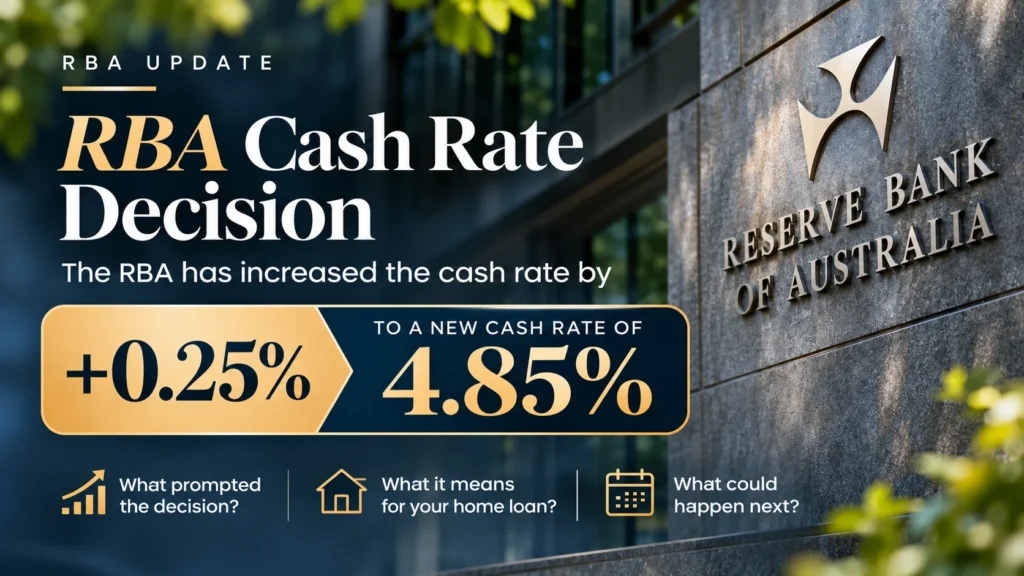
The Reserve Bank of Australia has lifted the cash rate by 0.25 percentage points to 4.85%, its highest level since November 2008. The decision was announced on Tuesday 3 November 2026, Melbourne Cup Day, and it is the fifth rise this year.
The cash rate started 2026 at 3.60%, so it has now climbed 1.25 percentage points in nine months. If you have a variable home loan, that is a real change to your household budget, and it is a good moment to check whether your loan is still pulling its weight.
In this article I’ll explain how the RBA reaches these decisions, what sits inside the basket of goods and services, what a rate at this level means for you, and why now is the right time to review your loan.
Why the RBA raised rates in November
The RBA raised rates because inflation is still too high and is taking longer to come down than it expected. Annual inflation was 4.3% in the 12 months to September 2026, well above the 2 to 3% target.
In its statement, the Board said inflation is not expected to reach the top of the target range until late 2027, around three quarters later than it previously forecast. It pointed to higher fuel and commodity prices linked to the conflict in the Middle East, and to many businesses passing on rising costs.
It was not a unanimous call. Six members voted to raise the rate and three voted to hold it at 4.60%, which shows how finely balanced this decision was with the economy slowing and unemployment rising.
How the RBA makes these decisions
The cash rate is set by the RBA’s nine-member Monetary Policy Board, which meets eight times a year. The Board is made up of the Governor, the Deputy Governor, the Secretary to the Treasury and six other members.
Its job comes down to two goals: keeping inflation between 2 and 3%, and supporting full employment. When inflation looks set to stay above target, the RBA will typically raise the cash rate to cool spending. When the economy needs support, it can lower it.
At each meeting, the Board weighs up a broad set of evidence, including:
- Inflation: how fast prices are rising, and whether the rises are widespread or limited to a few items
- Jobs: unemployment and how tight the labour market is
- Economic growth: household spending, business investment and productivity
- Housing: property prices, turnover and construction activity
- Global conditions: oil prices, trading partners and overseas conflicts
- Expectations: whether businesses and households start to assume high inflation is here to stay
That last one mattered this time. The Board warned of an increasing risk that higher inflation expectations could become embedded, which can make inflation harder to bring down.
What’s in the basket of goods and services
The basket of goods and services is what the Australian Bureau of Statistics uses to measure inflation through the Consumer Price Index, or CPI. It tracks the prices of what Australian households buy across 11 groups, collected in the eight capital cities.
Each group is weighted by how much households spend on it, so a rise in housing costs moves the index far more than a rise in clothing. Here’s how the basket looks, using the latest ABS weights and annual price changes to September 2026.
| CPI group | Share of basket | Annual price change |
|---|---|---|
| Housing | 21.4% | +5.2% |
| Food and non-alcoholic beverages | 17.4% | +3.2% |
| Recreation and culture | 12.7% | +4.5% |
| Transport | 11.5% | +8.7% |
| Furnishings, household equipment and services | 8.0% | +0.8% |
| Health | 6.7% | +3.7% |
| Alcohol and tobacco | 6.6% | +4.3% |
| Insurance and financial services | 5.6% | +3.9% |
| Education | 4.7% | +4.7% |
| Clothing and footwear | 3.3% | +0.4% |
| Communication | 2.1% | +2.3% |
A few items did most of the heavy lifting over the past year. Automotive fuel rose 23.6%, electricity rose 12.8% as Commonwealth rebates ended, and new dwellings rose 4.7% as builders passed on higher labour and materials costs.
Here’s a detail that surprises many people: your mortgage interest isn’t in the CPI basket. The housing group captures costs such as rents, new home purchases, maintenance, rates and utilities. So a rate rise doesn’t show up in this measure of inflation, even though you certainly feel it in your budget.
The RBA also looks past the headline number. Its preferred guide to underlying inflation is the trimmed mean, which removes the largest price swings each period. That measure was 3.6% over the year to September, still above target.
What a cash rate at its highest since 2008 means for you
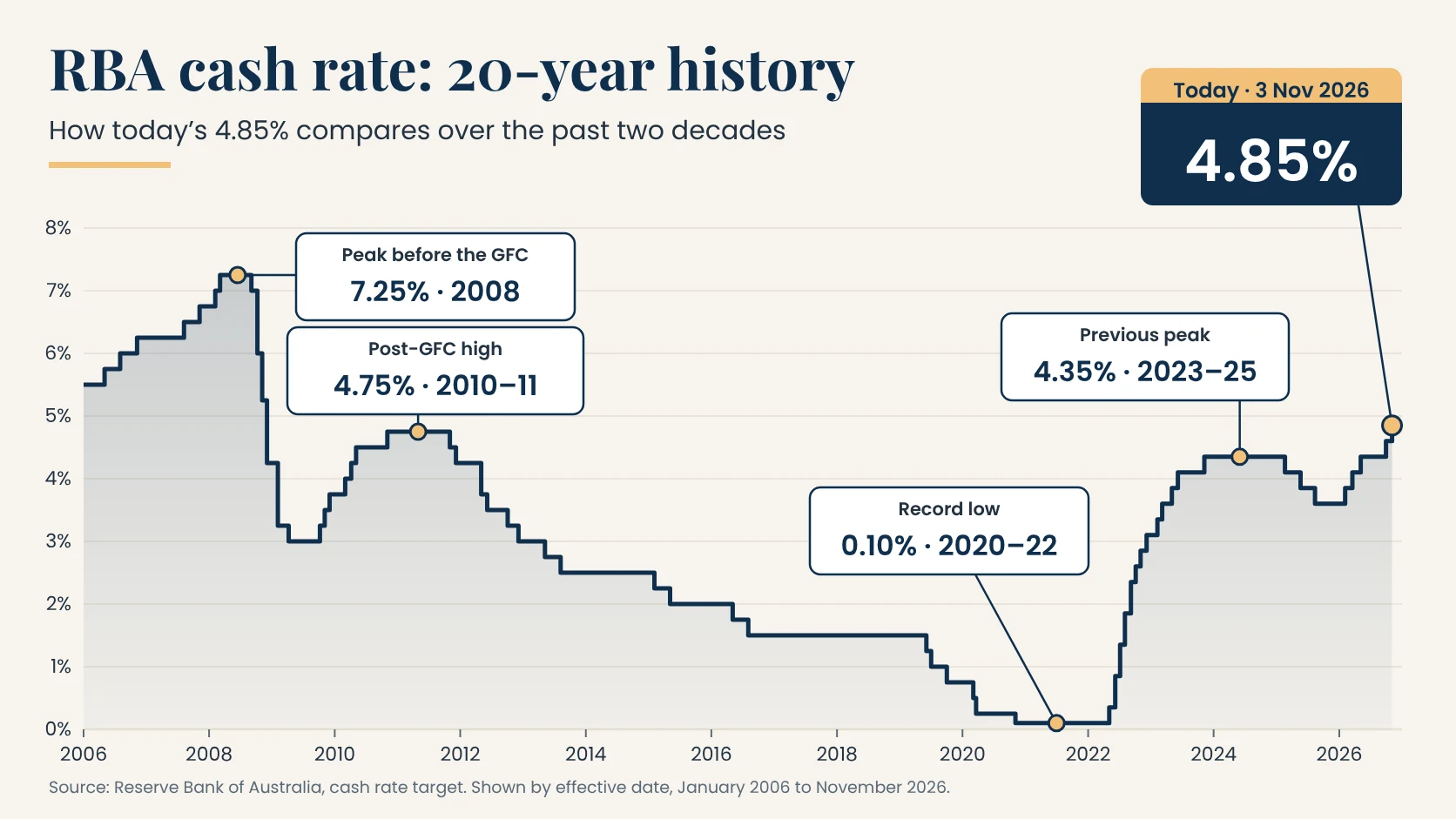
A cash rate of 4.85% is the highest Australia has seen in 18 years. To put that in context, the rate peaked at 7.25% in 2008, then fell quickly as the global financial crisis took hold. Anyone who took out a mortgage in the past 15 years has rarely, if ever, borrowed at rates like these.
Here’s what that means in practice.
Your repayments are likely to rise
At the time of writing, the major banks are yet to confirm their response. After the September rise, CBA, Westpac, NAB and ANZ all passed it on in full, so it’s sensible to budget for the same again.
Canstar estimates the impact looks like this if lenders pass on the increase in full.
| Loan size at start of 2026 rises | Extra per month from this rise | Extra per month across all five rises |
|---|---|---|
| $600,000 | $92 | $456 |
| $750,000 | $115 | $570 |
| $1,000,000 | $153 | $759 |
Based on 25 years remaining on the loan. Your own figures will depend on your rate, balance and loan term.
Your borrowing power may be lower
Lenders assess new loans at a rate at least 3 percentage points above the loan rate, so higher rates reduce what you can borrow. This matters if you’re planning to buy or invest. It also matters if you want to refinance, because you generally need to pass a lender’s assessment again.
Your offset account works harder
Every dollar in an offset account saves you interest at your home loan rate, so its value goes up as rates rise. If your savings are sitting elsewhere, or your loan doesn’t have an offset, this is worth a look. My article on offset vs redraw explains how the two compare.
The path from here isn’t certain
Nobody knows yet whether 4.85% is the peak. In notes published before the decision, NAB expected a pause, Westpac saw a growing risk of another rise in February, and CBA had pencilled in cuts for August and November 2027 if inflation improves. The RBA says it will be guided by the data, and it meets next in December.
The practical takeaway is to plan around what you can control, rather than waiting for a rate cut that may be some way off.
Why it’s important to review and refinance now
You can’t control the cash rate, but you can control the loan sitting underneath it. When rates are this high, every bit of difference between your rate and a sharper one is worth more, which is why now is the time to look.
Lenders often save their best rates for new customers, so a loan that was competitive a few years ago may not be today. Passing on a rate rise doesn’t mean your lender is offering you its best deal.
As a simple illustration, take a $750,000 loan with 25 years remaining. At 6.25% rather than 6.75%, repayments are about $234 a month lower, or roughly $2,800 a year. That’s more than the $115 a month Canstar estimates this rise will add to a loan of that size.
This is an illustration only, not a rate on offer, and any saving has to be weighed against the costs of switching. But it shows why the gap matters. One of my clients was told his bank had no further discount to offer. We refinanced and saved him $166 a month, while also releasing $70,000 for his renovation.
A review can help you:
- Secure a sharper rate by comparing your loan against what other lenders are offering
- Improve your structure with offset accounts, split loans or a mix of fixed and variable
- Consolidate higher-interest debt into one structured loan, with a plan to keep it there
- Plan ahead for a fixed rate ending, so you don’t roll onto a higher default rate
- Check your position early, because higher rates can make a lender’s serviceability test harder to pass
That said, a rate rise alone isn’t a reason to refinance. Break costs, exit fees and a reset loan term can all eat into the benefit, and sometimes your current lender will sharpen its rate to keep you. I walk through this in detail in my article, what to consider when refinancing your home loan, and I’d encourage you to read it before you make a move.
The point is to make the decision with real numbers in front of you. You can get a quick starting point with my refinance calculator.
Frequently asked questions
What is the RBA cash rate now?
The RBA cash rate is 4.85%, following a 0.25 percentage point rise on 3 November 2026. It is the fifth rise of 2026 and the highest level since November 2008.
Why did the RBA raise interest rates in November 2026?
The RBA raised rates because inflation remains above its 2 to 3% target and is now forecast to take longer to return. Annual inflation was 4.3% in the 12 months to September 2026.
How much will my repayments go up?
Canstar estimates about $92 a month on a $600,000 loan with 25 years remaining, if your lender passes on the rise in full. Your own increase will depend on your balance, rate and loan term.
Is the mortgage rate included in the CPI basket?
No. Mortgage interest isn’t part of the CPI. The housing group includes costs such as rents, new home purchases, maintenance, rates and utilities.
Should I refinance because rates have gone up?
A rate rise is a good prompt to review your loan, but it isn’t a reason on its own to refinance. It’s worth doing when the benefit outweighs the costs and the new loan suits your goals.
Let’s see if your loan is still working for you
Rate rises are unsettling, and you don’t have to work through this on your own. I’ll look at what you’re paying now, what switching would really cost across 70+ lenders, and whether a refinance would genuinely leave you better off. If staying put is the better move, I’ll tell you that too.
Before we talk, have a read of what to consider when refinancing your home loan. Then, when you’re ready, I’d love to help.
Prefer to talk now? Call me on 0450 275 656 or email durand@willowandreedprivate.com.au.
This article is general information only and doesn’t take into account your objectives, financial situation or needs. Figures are estimates and were current on 3 November 2026. Rates, lender policies and forecasts can change, and all lending is subject to lender approval. Please consider your own circumstances and seek advice before making a decision.