
A Limited Recourse Borrowing Arrangement, or LRBA, is the legal structure that allows your self managed super fund to borrow money to buy a single asset, with the lender’s recourse limited to that one asset if things go wrong rather than the rest of your fund. Understanding how LRBAs work, and where related-party loans fit in, is essential before you commit your SMSF to a property purchase.
This isn’t a client case study, it’s the technical grounding I walk every SMSF client through before we go anywhere near a lender, because the structure has to be right from day one or it can’t be fixed later.
What an LRBA actually is, and why super funds need one
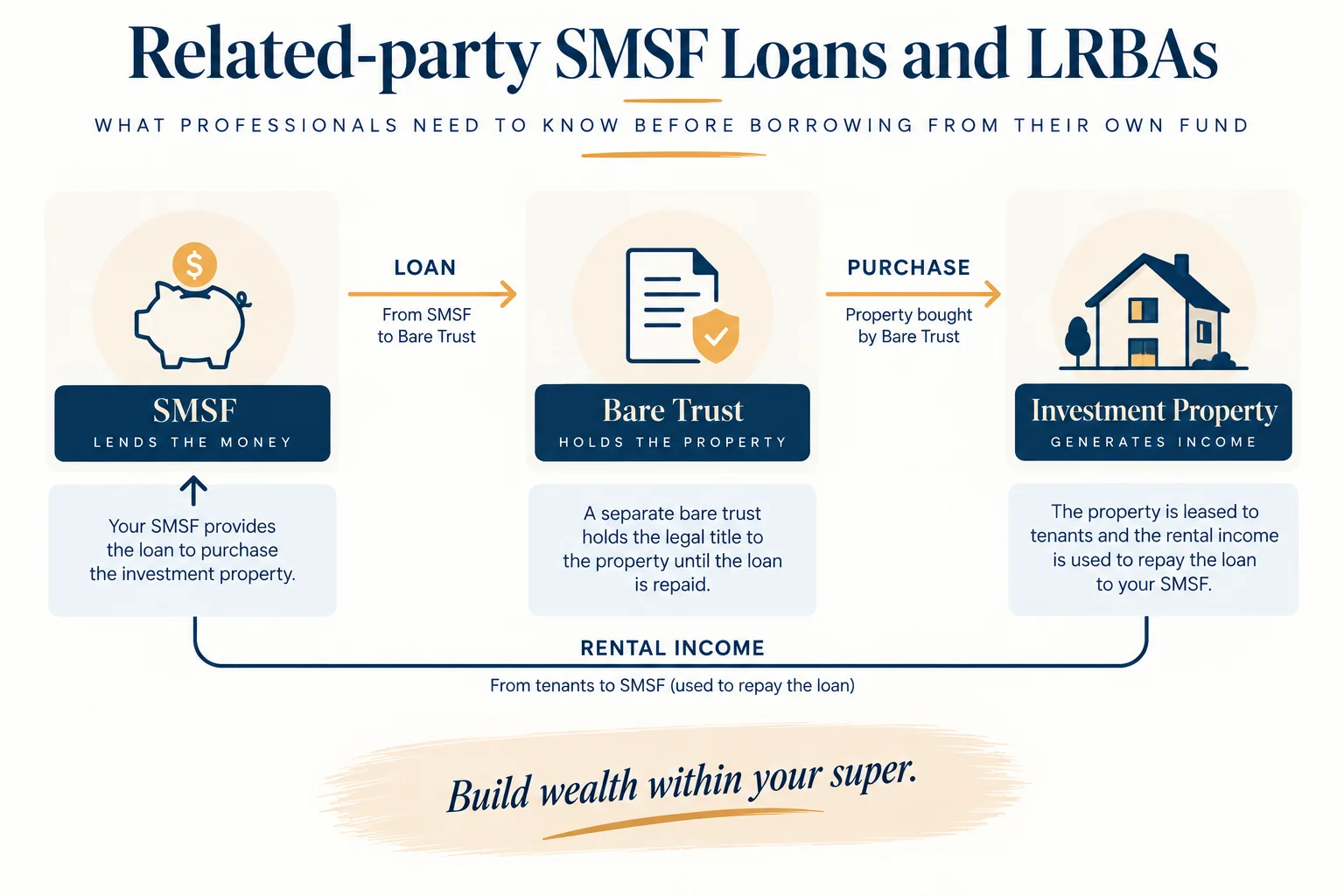
Superannuation law generally prohibits a fund from borrowing money. The LRBA is the specific, legislated exception that makes SMSF property lending possible. Under an LRBA, your fund borrows through a separate bare trust, sometimes called a custodian trust, which legally holds the asset until the loan is repaid. Your fund makes the repayments and receives the rental income and any capital growth, but the asset itself sits in the trust as security.
The “limited recourse” part matters most if something goes wrong. If the fund can’t meet repayments, the lender’s claim is limited to the property held in the bare trust, not the rest of your superannuation balance. This is the core protection that makes SMSF borrowing viable rather than reckless.
Related-party loans: lending your own fund the money
Instead of borrowing from a bank, some SMSF trustees lend money from their own resources, personally or through a related company, directly to their fund. This is allowed, but it comes with strict conditions set by the ATO.
- The loan must be on commercial terms. The interest rate, loan-to-value ratio, and repayment schedule must reflect what an arm’s-length commercial lender would offer, the ATO publishes a safe harbour rate benchmark each year.
- Documentation has to be genuine. A proper loan agreement, security registration, and repayment record are required, not an informal arrangement between trustee and fund.
- The structure still needs the LRBA. A related-party loan doesn’t bypass the bare trust requirement, the borrowing still has to sit inside a compliant LRBA structure.
Get any of this wrong and the ATO can treat the arrangement as a breach of the sole purpose test or the in-house asset rules, which carries serious consequences for the fund’s compliance status.
Why professionals consider related-party lending
For business owners and professionals with cash reserves outside super, or a family company with retained earnings, a related-party loan can solve a genuine access problem.
- Bank appetite for SMSF lending has tightened over recent years, and not every fund or property fits mainstream lender policy, particularly for commercial property or funds with a limited contribution history.
- A related-party loan can be structured with more flexible repayment terms than a bank, provided those terms still meet the ATO’s commercial benchmark.
- It can allow the fund to acquire an asset, such as a business premises, that supports the member’s broader financial strategy, while keeping the borrowing relationship within the family or business group.
None of this replaces professional advice, this is a strategy that sits squarely between lending, tax, and superannuation law, and getting one part wrong can undo the benefit of the other two.
Where LRBAs commonly go wrong
The technical requirements are unforgiving, and most compliance issues I see stem from a handful of recurring mistakes.
- Using the borrowed money to improve the asset in ways that change its fundamental character, which can breach the single acquirable asset rule.
- Setting a related-party interest rate below the ATO’s safe harbour benchmark, which can be treated as the fund receiving non-arm’s-length income, taxed at the top marginal rate.
- Skipping a proper bare trust deed, or setting one up after the purchase rather than before, which can invalidate the entire arrangement.
This is exactly why an LRBA purchase needs a broker, an accountant, and often a specialist SMSF lawyer working from the same page before any contract is signed.
Is this right for you?
If your SMSF is considering a property purchase and mainstream bank lending isn’t a fit, or you have capital outside super that could fund a compliant related-party loan, this is worth a proper conversation before you go looking at properties.
The structure needs to be right before you find the asset, not after, because retrofitting a bare trust or renegotiating loan terms after settlement is far harder than setting it up correctly from the start.
If you’re weighing SMSF borrowing against buying commercial property outright, it’s worth reading 7 key considerations when buying commercial property through an SMSF alongside this one.
Frequently asked questions
Can any SMSF use a related-party loan?
In principle yes, but the fund’s trust deed and investment strategy need to permit borrowing, and the trustees need to be genuinely comfortable managing the compliance obligations. It suits funds with trustees who have access to capital outside super and are prepared to maintain proper documentation.
What interest rate does a related-party loan need to charge?
The ATO publishes a safe harbour benchmark interest rate each financial year that related-party LRBAs are expected to meet or exceed. Charging below this rate risks the arrangement being treated as non-arm’s-length income, which is taxed far more heavily than ordinary fund earnings.
Do I still need a bank valuation and loan approval process?
For a related-party loan, no formal bank approval is needed, but a proper valuation and documented terms are still essential to demonstrate the arrangement is commercial and compliant. I’d treat the diligence the same way as a bank loan, even without the bank.
Can my SMSF borrow to buy residential property?
Yes, subject to the usual SMSF rules, including that the property can’t be lived in or rented by a fund member or their relatives. Commercial property, including business real property your own business occupies, is generally more common for related-party LRBAs.