

Lenders Mortgage Insurance (LMI) is a one-off premium that protects the bank, not you, and it typically applies once you’re borrowing more than 80 per cent of a property’s value. In plain terms, if your deposit is below 20 per cent, LMI is usually part of the equation.
For many professionals and families, the real question isn’t whether LMI applies, it’s whether paying it makes sense for their timeline and goals, or whether there’s a smarter way to reduce or avoid it altogether.
What LMI actually is
Lenders Mortgage Insurance is an insurance policy the lender takes out to protect itself, not you, if you default on your loan and the property sells for less than what’s owed. It’s typically required once your Loan to Value Ratio (LVR), the portion of the property’s value you’re borrowing, goes above 80 per cent.
Here’s a simple example to illustrate the mechanics. If you’re purchasing a $1,200,000 home with a $120,000 deposit (10 per cent), your LVR sits at 90 per cent, and LMI will almost certainly apply. This is a general example used to show how the maths works, not a specific client’s loan.
Why lenders charge it, and why you pay for it
From a lender’s perspective, a high-LVR loan is a higher-risk loan. If a borrower defaults and the property has to be sold at a loss, LMI covers that shortfall for the lender. The insurance protects the bank, but the premium is passed on to you, the borrower.
You can typically pay LMI as an upfront cost or capitalise it into your loan amount, spreading it over the life of the loan (with interest, which adds to the total cost over time).
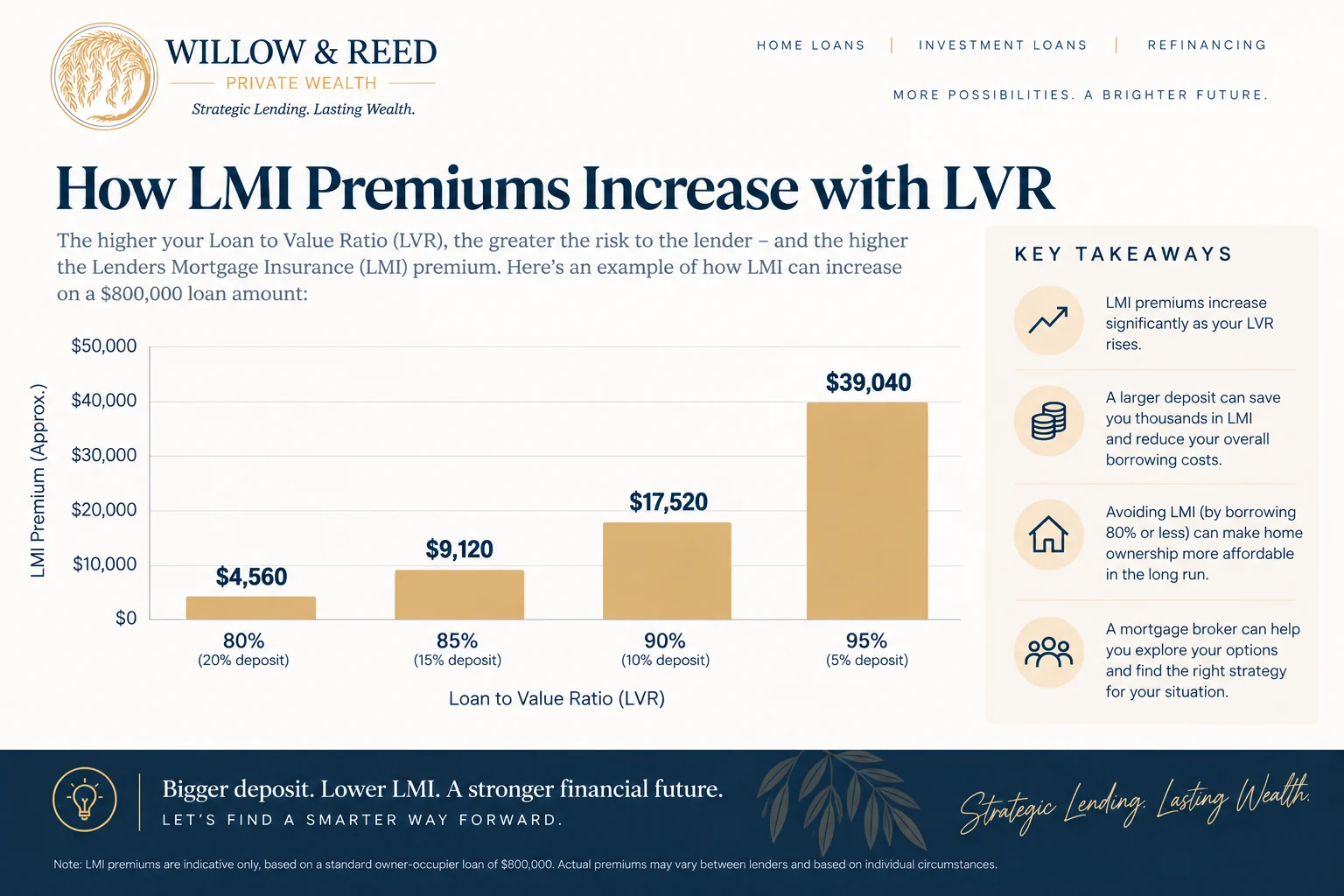
What determines the cost of LMI
The LMI premium is not a flat fee. It moves depending on:
- Your loan amount
- The size of your deposit
- Your employment or profession
- The individual lender’s pricing model
Some lenders waive LMI entirely for specific professions, including lawyers, accountants and medical professionals, sometimes with a deposit as low as 10 per cent. Knowing which lenders offer this, and structuring your application accordingly, is where a broker who understands your industry earns their keep.
How to reduce or avoid LMI altogether
There are several genuine ways to reduce or avoid LMI, and the right one depends on your situation:
- Saving a full 20 per cent deposit
- Using a guarantor, often a parent or close family member
- Qualifying for a professional LMI waiver
- Structuring your application with the lender most likely to offer flexibility for your circumstances
Not every lender offers the same concessions, and knowing which one to approach, and how to present your application, makes a real difference to the outcome.
Is paying LMI always a bad idea?
Not necessarily. For many buyers, paying LMI is a reasonable trade-off because it allows you to:
- Get into the market sooner rather than waiting years to save a bigger deposit
- Keep more cash in reserve for renovations, investing, or emergencies
- Benefit from capital growth on the property while you’re saving, rather than after
In a rising market especially, the cost of waiting to save a full deposit can end up outweighing the cost of LMI itself.
LMI is not the same as mortgage protection insurance
These two are commonly confused, but they protect different people. LMI protects the lender if you default on your loan, and it’s generally compulsory once your LVR is above 80 per cent. Mortgage protection insurance (sometimes called loan protection insurance) is an optional personal policy that can cover your own repayments if you’re unable to work due to illness, injury or job loss.
You can be required to pay LMI without ever taking out mortgage protection insurance, and vice versa. They’re worth understanding separately when you’re weighing up the full cost, and the full protection, around a new loan.
How LMI factors into a refinance
If you paid LMI on your original loan and you’re considering refinancing, it’s worth knowing that LMI generally isn’t refunded once your loan has settled, and in most cases you’ll need to pay a new LMI premium if your LVR on the new loan is still above 80 per cent.
This is one of the reasons it’s worth reviewing your numbers with a broker before refinancing, so you understand whether the savings on your new rate genuinely outweigh a fresh LMI cost, or whether it makes more sense to wait until you’ve built more equity.
How I help clients navigate LMI
I work with established professionals and families to make informed decisions about LMI, whether that means reducing it, negotiating a waiver based on your profession, or structuring your finance so it’s avoided altogether. Every strategy is built around your specific goals and timeline, not a one-size-fits-all rule.
This article is general information only and doesn’t constitute financial or credit advice. Please seek personalised advice based on your own financial situation.
Frequently asked questions
What is Lenders Mortgage Insurance (LMI)?
LMI is a one-off insurance premium that protects the lender, not the borrower, and it typically applies when you’re borrowing more than 80 per cent of a property’s value.
Do I have to pay LMI if my deposit is less than 20 per cent?
In most cases, yes, unless you qualify for a waiver (some professions receive LMI waivers), use a guarantor, or your lender offers another way to reduce your LVR below 80 per cent.
Can LMI be added to my home loan instead of paid upfront?
Yes, most lenders allow you to capitalise LMI into your loan amount rather than paying it as a lump sum, though this means you’ll pay interest on it over the life of the loan.
Which professions can get an LMI waiver?
Policies vary by lender, but professions commonly offered LMI waivers include lawyers, accountants and medical professionals, sometimes with a deposit as low as 10 per cent.
Is it ever worth paying LMI rather than waiting to save a bigger deposit?
Often, yes. Paying LMI can let you enter the market sooner, preserve cash for other priorities, and benefit from capital growth while you would otherwise still be saving, particularly in a rising market.