
Buying a house comes down to five things done in the right order: know your budget, understand what you can borrow, save your deposit, get pre-approved, then find and negotiate on the right property. Here is the full process I walk clients through, from the first budget conversation to settlement day.
None of this is complicated once you break it into steps. Most of the stress people feel about buying a house comes from doing the steps out of order, not from the steps themselves.

Step 1: work out your budget before you do anything else
Most people skip this step. They go straight to looking at houses and only work out their budget afterwards, and that’s a reliable path to disappointment.
Get the fundamentals right first. You need to know, in detail, what your income and expenses look like each month. Plenty of apps and budgeting tools can help with this, or you can keep it simple with a spreadsheet. Either way, work out how much you can genuinely afford to save and how much you can afford to repay.
One tip: if you’re currently renting and buying a home to live in, leave your rent out of the calculation. That cost disappears once you own your own place.
Step 2: work out how much you can actually borrow
Once you know your savings and repayment capacity, the next step is working out how much you can comfortably borrow. Most lenders and comparison websites have free borrowing calculators.
These calculators usually let you test different interest rates. Be conservative here, use a rate two to three per cent higher than the current rate, so you get a realistic picture of what you can borrow and whether you could still service the loan if rates rise. This is exactly the kind of thing I help clients work through, because I can point you toward lenders likely to approve you based on your financial position, dependants and savings history, rather than you guessing and applying blind.
Step 3: save your deposit (and understand the extra costs)
Once your budget has a rhythm, stick to it. A quick tip: pay down short-term debt like credit cards and personal loans where you can. Lenders view this favourably, and it improves your borrowing capacity.
A typical savings goal is 20% of the property value, so that’s $100,000 for a home valued at $500,000. On top of that, budget for stamp duty, transfer fees, government fees and insurance. If getting to 20% isn’t realistic in your timeframe, that’s fine, you’ll just need to factor in Lenders Mortgage Insurance (LMI) on top of the other costs. The closer you get to a 20% deposit, the less you’ll pay in LMI overall.
There are strategies to manage LMI and reduce these costs, and it’s worth discussing your specific situation before assuming you know what you’ll pay. If you want to understand LMI properly before you budget for it, I’ve written a dedicated piece on what LMI is and whether you really need it.
Step 4: find a loan product and lender that actually suits you
We’re in one of the most competitive lending markets in years, and that works in your favour if you use it. Don’t choose a loan purely on the interest rate. If a rate looks too good to be true, it usually is, and the lender has likely loaded the product with fees elsewhere, or made it difficult to refinance away later.
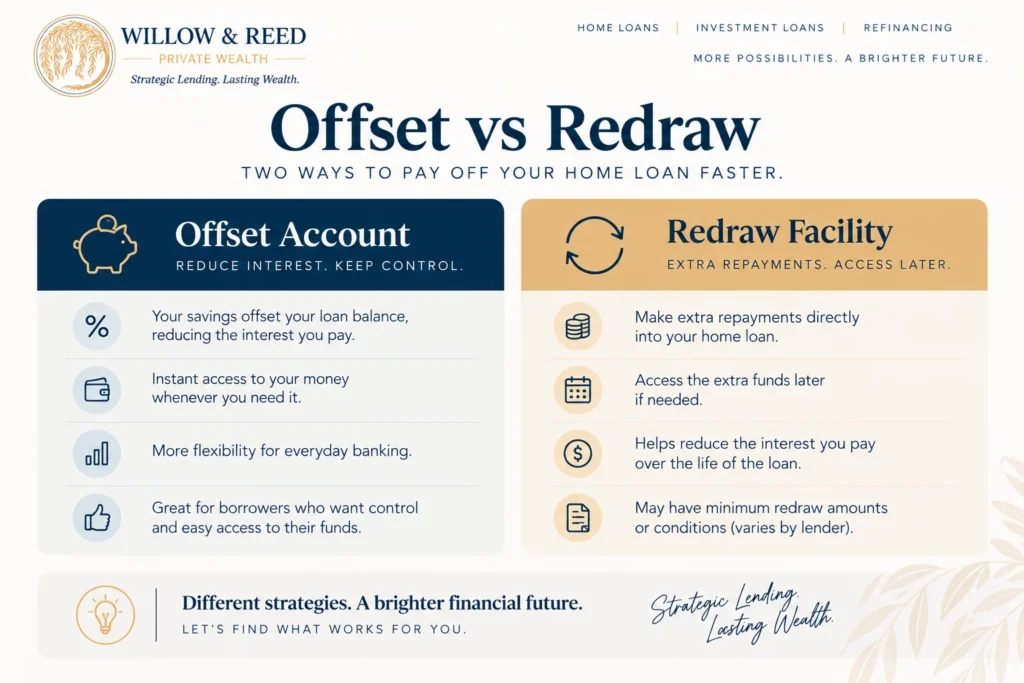
Loan features matter as much as the rate. Work out what’s important to you: extra repayments, access to those extra repayments in an emergency, repayment certainty, or paying fortnightly instead of monthly. Write a list of your must-haves, then shop around for the lender offering the best rate against that list, not the other way around.
Step 5: get pre-approval before you start negotiating
Pre-approval is one of your strongest assets when it comes to negotiating and making an offer. Sellers favour buyers who are ready to move, and if you find a seller who wants to sell quickly, they’ll gravitate toward buyers who can act.
Once you’ve chosen a lender, follow their process to get pre-approved. This is usually subject to a few conditions, including a valuation of the property once you find one, so the lender is comfortable progressing to the final stage. Pre-approvals are typically valid for up to six months. If yours is close to expiring, we can help extend it or reapply.
Pre-approval doesn’t commit you to a loan and it isn’t a loan offer, it simply confirms your affordability so you can shop with confidence. You’ll need to provide evidence of income, tax returns, proof of savings history and any other documents your lender requires.
Step 6: search for a house with a clear brief
This is the fun part, but don’t get carried away. Know what you’re buying and, just as importantly, why. Are you starting or growing a family? Would a house suit you better than an apartment? Do you want to renovate or build? Where do you want to live, and why, whether that’s community, transport links, or being close to cafes and shops.
Focus on your must-haves over your nice-to-haves when you’re torn between properties. Keep an open mind but stick to your budget. Do your research, talk to agents, use free property data sites, attend inspections and auctions, and don’t rush. This decision deserves the time it takes.
Step 7: negotiate and make your offer
Once you’ve found the house, keep your emotions in check. A calm, level-headed approach is what gets you the best price. Just as you wouldn’t buy a car without test driving it, don’t make an offer without a building and pest inspection.
A building inspection checks for structural issues, dampness, electrical faults and safety concerns, and flags any repair or maintenance costs. A pest inspection checks for termites, rodents and other pest issues. Depending on what comes back, you might walk away, or factor the repair costs into your negotiation. Don’t skip this step, it can be the difference between the home you wanted and a costly mistake.
You’ll also decide how to buy, whether through a private sale or at auction. If you’re heading to auction, attend a few beforehand to get a feel for the pace and bidding, and consider taking an experienced person with you or engaging a buyer’s advocate. If you win at auction, you’ll need to pay the deposit immediately, typically 10% of the purchase price, and there is no cooling-off period. My guide on how to bid at an auction covers this in more depth.
Private sale is the more common route, usually through a real estate agent. Ask for the Section 32 Vendor Statement and pass it to your solicitor for review. By law, the Section 32 must disclose all required information about the property’s condition and status. From there, you make a verbal offer, then a conditional or unconditional offer in writing. The seller prepares a contract of sale outlining the deposit and payment timeframe. Read the contract carefully, and if you’re unsure, have a solicitor or conveyancer review it and report back before you sign anything.
Step 8: finalise your loan
Once you’re happy with the contract terms, contact your lender to finalise your loan. You’ll need to provide a signed, executed copy of the contract of sale and pay your deposit to the seller. You’ll also need home and contents insurance in place, with a start date on or before settlement, since this is usually a condition of finalising your loan.
Step 9: settle on your new home
Settlement day is when the property title transfers into your name, in exchange for the seller receiving the full purchase price. Your solicitor or conveyancer typically finalises settlement between your lender and the seller, and instructs the lender to disperse funds for stamp duty, transfer fees and government fees.
Frequently asked questions
How much deposit do I need to buy a house in Australia?
A typical target is 20% of the property value, for example $100,000 on a $500,000 home. If you can’t reach 20%, you can still buy with a smaller deposit, but you’ll need to factor in Lenders Mortgage Insurance on top of stamp duty, transfer fees and other costs.
How long is mortgage pre-approval valid for?
Pre-approval is typically valid for up to six months. If it’s close to expiring before you’ve found a property, you can work with your lender or broker to extend it or reapply.
What’s the difference between a building inspection and a pest inspection?
A building inspection checks for structural issues, dampness, electrical faults and safety concerns. A pest inspection checks for termites, rodents and other pest issues. Both should be done before you make an offer, not after.
Do I need a deposit straight away if I buy at auction?
Yes. If you’re successful at auction, you’re required to pay the deposit immediately, usually 10% of the purchase price, and there is no cooling-off period, unlike most private sales.
What is a Section 32 Vendor Statement?
It’s a legally required disclosure document a seller must provide in a private sale, containing information about the property’s condition and status. Your solicitor should review it before you make an offer.