

A deposit bond lets you secure a property purchase without handing over a cash deposit at exchange, which means the money that would have sat idle in a solicitor’s trust account for months can keep working for you elsewhere. For professionals selling shares, waiting on a bonus, or simply not wanting to disturb an investment portfolio, it’s one of the more underused tools in property buying.
This isn’t a client case study, it’s a structuring option worth understanding before your next purchase, because most buyers only hear about deposit bonds after they’ve already tied up cash they didn’t need to.
What a deposit bond actually is
A deposit bond is effectively an insurance-backed guarantee. Instead of transferring 10% of the purchase price to the vendor’s solicitor at exchange, you pay a smaller premium to a deposit bond provider, who guarantees the deposit amount to the vendor. At settlement, you pay the full purchase price as normal, and the bond simply expires unused.
The vendor gets exactly the same security they would from a cash deposit. You keep your capital invested, in the market, in an offset account, or held back for another purchase, right up until settlement day.
Why professionals use them instead of cash
The appeal isn’t really about not having the money, most clients who use deposit bonds could write the cheque. It’s about what that money is doing in the meantime.
- Capital stays invested. Selling down shares or managed funds to fund a deposit, then buying back in after settlement, creates unnecessary transaction costs and market timing risk.
- Offset accounts keep working. If your deposit is sitting in an offset against an existing mortgage, moving it out to fund a new deposit costs you interest savings for however long settlement takes.
- Timing mismatches get solved. If your deposit is tied up until a bonus lands, an asset sells, or a term deposit matures, a bond bridges the gap without forcing an early exit from anything.
Where it gets more nuanced is if settlement is delayed. Most bonds run for a fixed term and longer settlements, common with off-the-plan purchases, can mean a higher premium or a bond that needs extending.
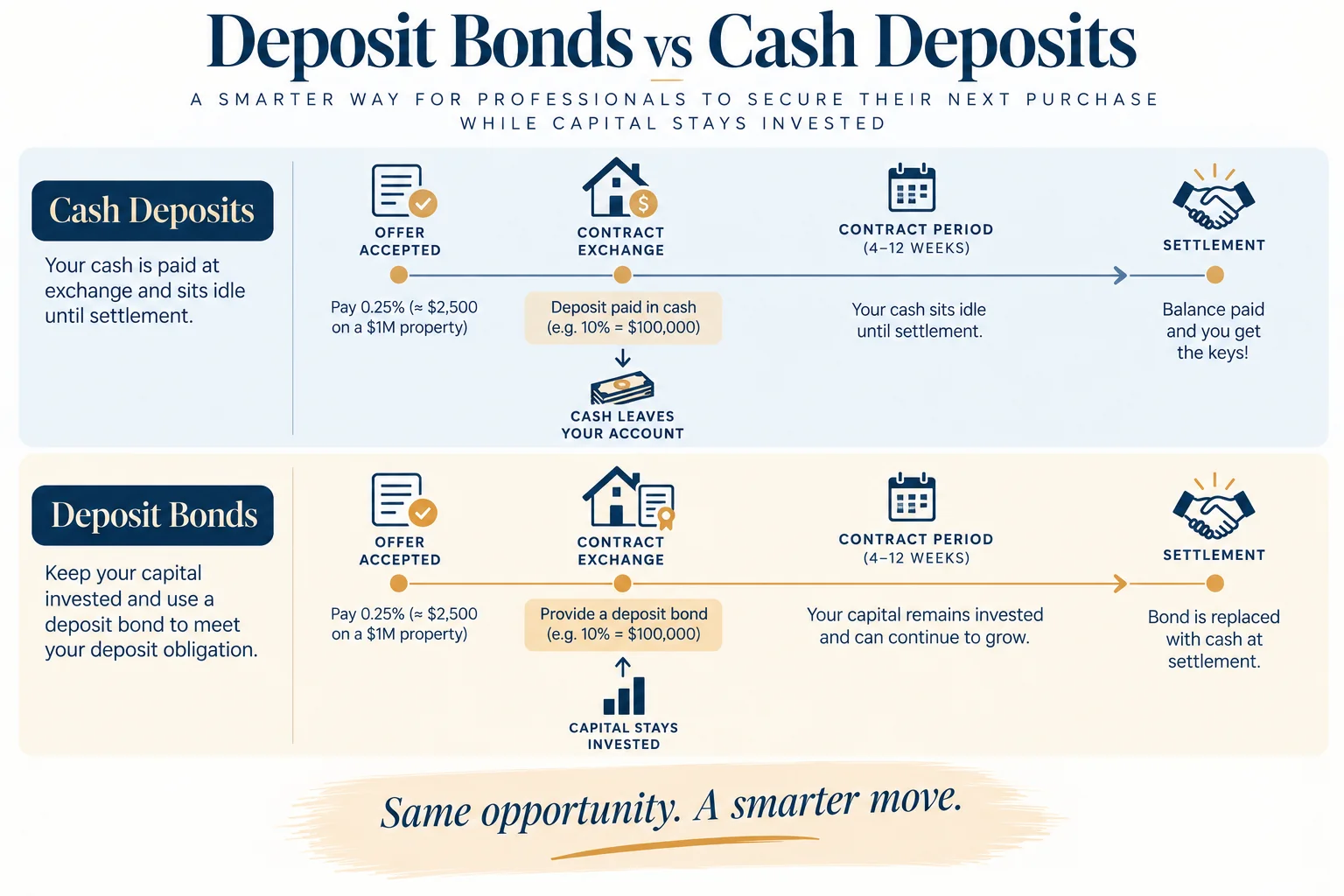
What it actually costs, and what you get back
The premium for a deposit bond is a genuine cost, it’s not refunded, so it needs to be weighed against what you’re saving by not moving cash.
- Premiums are typically a small percentage of the deposit amount, scaled by settlement timeframe and the deposit size, so short standard settlements cost the least.
- The interest saved by leaving money in an offset account, or the return kept invested rather than realised early, often outweighs the premium for anyone with a genuinely productive use for the capital.
- For off-the-plan purchases with a settlement 12 to 24 months out, the bond premium can be meaningful, and it’s worth comparing directly against the cost of parking cash for that long.
The maths only works in your favour if the capital was actually going to do something useful elsewhere. If it was just going to sit in a low-interest savings account, a cash deposit is usually the simpler, cheaper choice.
When a deposit bond isn’t the right tool
It’s not always the better option, and I’d rather tell you that upfront than sell you on a product that doesn’t fit.
- If your capital has nowhere more productive to go in the meantime, the premium is a cost with no offsetting benefit.
- Some vendors, particularly in private sales, are less familiar with deposit bonds and may push back, which can complicate negotiations on a competitive purchase.
- Longer settlement periods increase the premium, sometimes enough to erode most of the benefit.
A five-minute conversation about your specific settlement timeframe and what the capital would otherwise be doing usually makes the answer obvious either way.
Is this right for you?
If you’re a professional buyer with capital that’s genuinely working for you elsewhere, invested, offsetting a mortgage, or earmarked for something else in the near term, a deposit bond is worth at least pricing out before your next purchase.
It’s a small piece of a bigger buying strategy, and it works best alongside the rest of your lending structure being right, not as a standalone decision.
If you’re timing a purchase around selling your current home first, it’s worth reading bridging loans in Australia alongside this one, since the two strategies solve related but different timing problems.
Frequently asked questions
Is a deposit bond the same as a bank guarantee?
No. A deposit bond is issued by a specialist insurer or bond provider and is specific to that one purchase. A bank guarantee is a separate product, usually tied to your existing bank and often requiring cash or security to be held against it. Deposit bonds are generally more flexible and don’t require you to tie up other assets.
Can I use a deposit bond for any type of purchase?
Most vendors accept them for established properties and off-the-plan purchases, but not all do, particularly in private treaty sales where the vendor’s solicitor may be unfamiliar with them. I’d always check acceptance before you rely on one at auction or in a competitive offer situation.
What happens if settlement is delayed?
Most bonds are issued for a fixed term matching the expected settlement date. If settlement is delayed beyond that, the bond may need to be extended for an additional premium, so it’s worth building some buffer into the term if your settlement timeline is uncertain.
Do I still need to prove I can afford the deposit?
Yes. Deposit bond providers still assess your financial position before issuing one, since they’re guaranteeing that you’ll settle. It’s not a way around normal lending checks, it’s a way to avoid moving cash you don’t need to move yet.