

From 1 July 2027, a new build will be the only type of residential property that keeps full negative gearing against your other income, and that single change is enough to reshape how a serious investment strategy should be built from here. Rather than treating the reform as a loss to absorb, professionals who plan around it properly can use it as the basis for a genuinely stronger long-term wealth strategy.
This isn’t a client case study, it’s the strategic conversation I’ve been having with clients since the reform passed, because the investors who move deliberately now will be better positioned than those who wait and react later.
Why new builds just became the structurally stronger choice
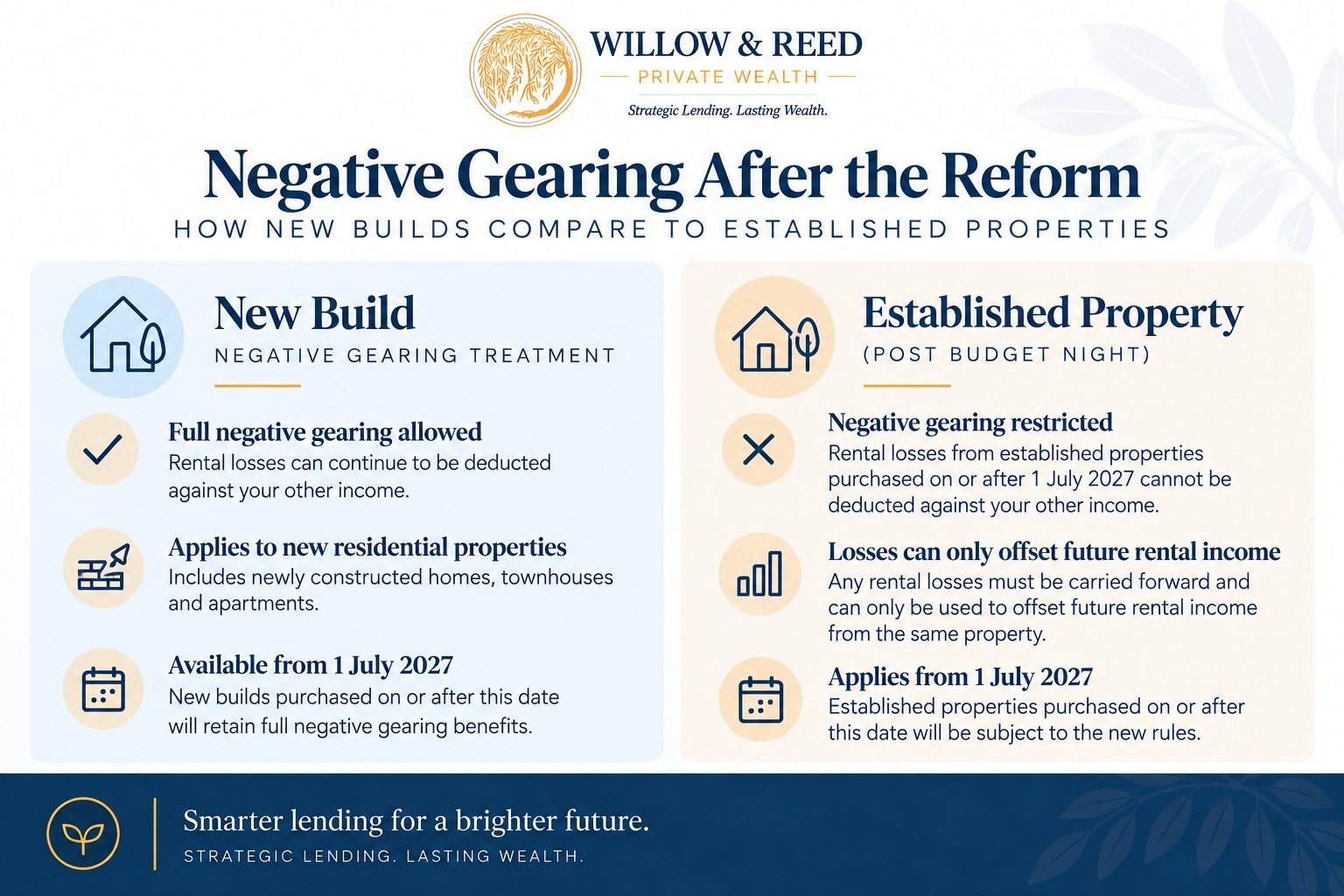
Under the current rules, established and new properties are taxed identically for negative gearing purposes, so the decision has mostly come down to price, location, and growth potential. From 1 July 2027, that’s no longer true. A new build purchased at any time keeps full negative gearing against your salary and other income indefinitely. An established property bought after budget night only offsets losses against its own rental income, with the balance carried forward rather than reducing your tax now.
For a high-income professional in a meaningfully higher tax bracket, that difference in immediate tax benefit is not trivial, and it’s now a structural feature of the property itself, not just a timing quirk.
Building a strategy around the new-build advantage
A considered approach treats the reform as one input among several, not the only reason to buy.
- Off-the-plan and house-and-land packages become more attractive purely on tax grounds than they were previously, provided the underlying fundamentals, location, builder quality, and genuine demand, still stack up on their own merits.
- Build-to-rent and new-construction investment in growth corridors can combine the retained negative gearing benefit with strong capital growth potential, a combination that’s now more clearly differentiated from buying established stock.
- Timing your purchase relative to 1 July 2027 matters less for new builds specifically, since the full benefit applies regardless of purchase date, unlike established property where budget night is the line that determines treatment.
None of this means an established property is now a poor investment, it means the case for it needs to stand on yield and growth alone, without the same tax offset doing extra work.
How this fits into a broader wealth-building structure
A single new-build purchase is rarely the whole strategy, it’s a piece that needs to sit alongside your existing lending structure and long-term plan.
- Serviceability still needs to support the purchase in full, quarantined losses on other properties don’t reduce the income a lender counts, so your borrowing capacity calculation doesn’t change just because you’re buying a new build.
- Loan structure matters as much as property selection, a well-structured split between fixed and variable, and the right offset arrangement, still drives real savings independent of the tax treatment.
- Diversifying across new builds and, where the numbers stack up, a well-chosen established property, can balance the tax efficiency of new construction against the sometimes stronger long-term growth profile of established, well-located stock.
The reform changes one input into the decision, it doesn’t replace the need for a genuinely sound overall structure.
What to actually do in the lead-up to 1 July 2027
There’s a real window here to plan deliberately rather than scrambling once the rules take effect.
- If you’re weighing an established property purchase, understand clearly where your settlement date sits relative to budget night and the 1 July 2027 start date, since this determines the tax treatment you’ll actually receive.
- If new-build investment fits your broader goals, starting the research and pre-approval process now means you’re ready to act rather than rushing a decision as the deadline approaches.
- Review your existing portfolio’s structure now, since grandfathered properties are unaffected but your overall lending strategy may still benefit from a refresh regardless of the reform.
The professionals who benefit most from a change like this are usually the ones who planned around it early, not the ones who reacted after the fact.
Is this right for you?
If you’re planning to grow your investment portfolio in the next one to two years, this reform is worth building into that plan now, while there’s genuine time to structure around it properly.
It’s particularly relevant if you’re deciding between an established property and a new build for your next purchase, since the tax treatment is no longer the same regardless of which you choose.
If you’re also weighing up how your ownership structure affects the numbers, it’s worth reading new negative gearing rules explained alongside this one for the full detail on what’s changing and when.
Frequently asked questions
Will a new build always be negatively geared against my other income?
Under the reform as currently legislated, yes, a new build retains full negative gearing against your other income, unlike an established property bought after budget night. This is a deliberate incentive to direct investment toward new housing supply, so it’s specific to genuinely new construction rather than a broader category.
Is buying a new build purely for the tax benefit a good strategy?
Not on its own. The tax treatment is a genuine advantage, but a sound investment still needs to stand on location, demand, build quality, and growth potential. I’d never recommend buying a property solely for a tax outcome, the fundamentals need to work regardless of the negative gearing treatment.
Does this reform affect how much I can borrow?
Not directly. Your borrowing capacity is still assessed on your income, expenses, and existing commitments in the usual way. The reform changes the tax treatment of losses after you’ve bought, not the lending assessment itself, so it’s worth understanding both separately.
Should I rush to buy an established property before the rules change?
Not without thinking it through properly. Buying before 1 July 2027 doesn’t grandfather an established property, only holdings from before budget night on 12 May 2026 are protected. A rushed purchase to beat a deadline that doesn’t actually apply to you is rarely a good reason to buy.